(Q) We Indians have a popular narrative of Unity in Diversity. However, although most of our major states have their own rich history, culture and languages, other Indians are ignorant about them. This is so because the details of these are available only in that particular language. Many people interested in these want to understand them through the concerned language. Here I shall take the Kannada language as an example. People who wish to learn about Kannada culture etc from original and authentic sources have to learn it through the Kannada language. However they find it an uphill task because the script of the language, which is illegible to them, becomes a major hurdle. Very few people have the patience to learn a new script and then read the required information. As a result the desired culture, history etc remain remote and inaccessible. This becomes a big hurdle in creating a common bonding between different cultures of India and people are compelled to live inside the boundaries of their own language and culture. So the principle of Unity in Diversity remains on paper alone, due to the seemingly unsurmountable problem of illegible script.
This problem can easily be solved by accepting the Devnagri script as the universal / common script for all Indian Languages, including English. However it is essential to understand here that the original script of the Kannada language will be kept in use as always, the Devnagri script will be used along with it for the benefit of those who don’t understand the Kannada script and are unable to study it due to some reasons. Then such people will be able to read Kannada but in Devnagri script.
Another more important reason for adopting Devnagri script is linked to the prosperity of the state. It is an accepted fact that outside people and their money contributes to the prosperity and wealth building of the state. These outsiders, being non Kannadigas, will be able to mix with the locals and work for the state and its populace, if the Devnagri script is available everywhere along with the Kannada script. On one hand this will help improve the state’s economy and on the other hand these outsiders can learn Kannada more easily.
This one step will help, in a big way, in spreading the Kannada language and thereby Karnataka’s history and culture. This I think is the dream of lovers of the Kannada language. This will also help in creating a bonding between Kannadigas and all other Indians. The Kannada language is taken as an example to make the point easy to understand. It can be replaced by any other language like Tamil, Bengali, Punjabi etc.
Why Devnagri script only?
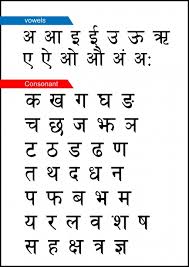
One question is bound to be asked. When we have so many scripts, why choose Devnagri only. One reason is that it is the most rule based language. It has got vowels which cover a wide range of pronunciations. Its consonants are systematically grouped covering different types of pronunciations. If you follow the rules properly, words can be pronounced precisely indicating its exact meaning, leaving no room for confusion. Second reason is that all our ancient scriptures as well as epics are in Sanskrit. It is taught in schools and colleges even outside India and widely used for giving quotations during debates. Nowadays it is also available on computers and mobile phones. Hence it deserves to be the universal / common script for all the Indian Languages and English as well.
(1) Devnagri needs Updating
Though Devnagri can cover a wide range of pronunciations, it falls a little short when using it for languages like English, Urdu and Kannada etc. Hence it is necessary to add some vowels and modifications in some consonants as below.
Additional vowels required –
At present the Marathi script uses 12 vowels which are called ” Barakhadi “
(बाराखडी ) – अ आ इ ई उ ऊ ए ऐ ओ ओो अं अ:
Kannada script uses 2 extra vowels ए (दीर्घ ) and ओ (दीर्घ ). This makes it 14 vowels system (चौदा खडी ). Hence 2 extra vowels need to be added. In addition to this, since English requires अ (दीर्घ ), as in earn, us. This can be written as अ s. It also uses ॲ and ऑ as in apple and odd. Hence for English pronunciation, these 3 vowels also need to be added.
Thus the total vowels will become 17. This may be sufficient for most uses.
Some additions are needed in consonants also, especially for Hindi and Urdu languages. Some of these are -1) ज आणि – This is used in Hindi for राज (secret) and (kingdom) and in Urdu for जलील (कमीना ) आणि (highly respected). There are other examples also. So this Nukta should also be included in the Devanagari script.
I have mentioned the above additions as per my very limited knowledge. Some other additions may also be needed which can be pointed out by the language experts.
When all Indian Languages along with English will be written in the Devanagari script along with its own script, the language which was previously illegible to others, will then become legible and thus other language users will be able to use and communicate in that particular language also. This will help in increasing the usage of all languages throughout India and also help in uniting all Indians through better understanding of different cultures and histories of different languages. This will promote the spread of different languages, rather than diminish it.